
Interview
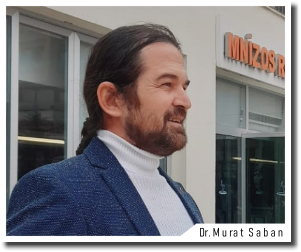
Kutlu Writers Magazine: Interview with Author Murat Saban PhD on Writing

Why do you write? Is writing for you an occupation, or a necessity?
I write because writing organizes my thoughts. It is a kind of therapy, a mental exercise, and at the same time quite enjoyable. Writing is not wasted time for me; on the contrary, it is something I must do. I see my works as message bottles sent into the future. One day, someone will open the cork of that bottle and find what they need inside. That thought is what makes me happy.
Do you remember the first time you wrote; how did you begin?
In fact, a few friends and I started with the idea that “we must create a work.” Everyone would write a story of their own, and we would turn it into a book. But in the process, they all realized that writing was not as easy as it seemed and gave up. I continued, and I tasted it.
What did you feel when you signed your book for the first time? What was your first thought when a reader handed you your book to sign?
Unfortunately, I have not yet attended any signing days. But the idea that one day readers will hand me my book and ask for my signature excites me. Because at that moment, I will be able to see with my own eyes that my thoughts from the pen have connected with someone. I hope that day will come.
Have you ever been to a book fair? Can you describe the feelings from the moment you entered the building to walking through the stands?
From the very first step, I feel as if I am passing through the gates of a colorful realm. On one side science fiction, on the other fantasy… Each book stand seems to open into another world. I pick some up, carefully open their covers, and glance inside. For some I say, “Yes, I must buy this and read it.” I am especially interested in the works of new authors. Those works feel like a new universe of thought I have never encountered before; I suppose I love to discover.
Do book fairs contribute to our reading culture? In recent years, they have begun to be organized in every city. What do you think about this?
I believe book fairs make a great contribution to our reading culture. Because fairs bring people together with books; they allow new authors to become visible. The fact that they have started to be organized in every city in recent years is very valuable. In this way, reading culture spreads not only in big cities but across the entire country. I see fairs not merely as book sales, but as the discovery of new universes of thought and as a cultural ritual.
What do you do when writing? Do you have a method of your own?
I do have a method of my own. First, I organize my thoughts, then I divide them into scenes and put them into writing. Silence is important for me; because during the mental construction process, my mind is quite noisy. Considering that I also take into account the variants of a scene, if you knew how many times I replay a scene in my mind, you would probably call me “crazy.” I define the writing stage as the externalization of mental activity. Capturing fluidity is crucial; words, sentences, and paragraphs must all complement each other in unity. Because if you cannot correctly transfer what passes through your mind into writing, you cannot fully reflect the magic of those scenes. Therefore, I can say that every writer is, in a sense, an architect.
Do you have any local or foreign authors you take as an example? Any whose style you admired and followed?
Of course, I have read the works of many authors, but rather than taking examples when writing, I prefer to construct my own scenes. Even if I admire an author’s style, I pay special attention to ensure that my style does not resemble theirs. Originality is very important to me.
What do you think about the value of literature today? How do you evaluate its place within the conditions of our age?
The value of literature today lies in its ability to offer lasting depth against rapidly consumed content. Within the conditions of our age, literature serves both as individual therapy and as collective memory. I see literature not only as art but also as a channel of communication between generations.
Can you write about a feeling you have never experienced? How would you make such a text feel natural to the reader?
I think I have a problem in this regard. In fact, my style does not emphasize emotions in my writing. I focus more on mental description. To describe a character’s anger, for example, I dwell on the behaviors they would display when angry, and I leave it to the reader to infer that the character is angry. With this method, the reader extracts the emotion not directly from me, but from within the scene itself. What I generally aim to do is not to narrate a feeling, but rather to establish a bond between the character and the reader. And whether I succeed in this, I honestly do not know.
Do you ever speak of yourself in your stories or poems?
I do not speak of myself directly. But a part of me is always present in my works. I want to touch, I want to meet in words. Because for me, writing also means communicating with the person who reads it. We could call this a desire to open a corridor of mental resonance. Think about it: opening the cover of a book and beginning to read is actually like walking inside the mind of its author.
To whom do you first show what you have written? Why?
Sometimes I use an editor, sometimes I ask a friend. There are times when I need a younger mind depending on the nature of the work; in such cases, my children help me. We call this process “the final reading before printing.” The main reason I do this is to understand whether I have fully reflected what is in my mind onto paper. If we detect such a problem at the final reading stage, I review my sentences and contexts again.
What do you feel when you read a work whose plot you do not like? Is there a work you have said, ‘If it were me, I would have written it differently’?
Yes, but I think it would not be right to give names. I often greet the plot mistakes that new writers can make with a smile. Their making mistakes is not very important; their effort is what matters. However, I have subjected works that were promoted as “masterpieces” or became bestsellers to multi‑dimensional analysis, including style, context, and narrative techniques. By the way, I think some famous authors use ghostwriters. Because I encounter such inconsistencies between works that I am truly surprised.
How often do you go to bookstores? What do you pay attention to when buying books? What would be the first book you recommend to your readers?
I try to go once a month. Besides looking at new works, I enjoy breathing in that atmosphere. Walking among the shelves, wandering between genres is truly a beautiful feeling. Time passes so quickly that when I enter a bookstore at noon, it may be dark when I leave. When buying books, I usually choose those that can help me in my research topics. For example, before writing my novel Sadece Beni Sev (Just Love Me), I read many academic articles about the Goths and the Romans and bought books on the subject. In this context, I recommend to friends interested in the topic the work Roman History written by Ammianus Marcellinus and translated into Turkish by Samet Özgüler, which caught my attention with its rhetorical style.
Pen or keyboard? Which should one write with?
For me, the writing itself is more important than the tool. Writing with a pen leaves a ritualistic trace, while the keyboard carries thought to the scene more quickly. I think this choice is related to how the writer feels more authentic. If I were a poet, I would have my poems printed in my own handwriting. But my handwriting is quite poor, and I am not a poet. That is why I prefer the keyboard.
What would be your final words to your readers?
I thank everyone.
Original Turkish interview published in Kutlu Writers Magazine.