
Ink Revolution
Truths appear when you are ready. | By Murat Saban (PhD)

Interrogation
A room. Windowless. Stone walls, spotless as if dressed in the sterility of a stage being set. The gray floor, preparing for the rehearsal of a scene not yet begun, is silent. The lamp hanging from the ceiling, like a pendulum swinging between existence and nonexistence, neither illuminates nor allows darkness. Each flicker of its yellowish light seems to whisper, “come on, speak.” Clearly, the room awaits a confession.
— Did you write this text?
There are dozens more questions waiting for answers. Each one a lock, each one a threshold, each one a passage opening to another. The sequence of questions has been meticulously planned; when the yellowish light flickers once more, the same question returns; but this time the tone is different, more pressing, more suffocating, as if the room is shrinking; the stone walls, the gray floor draw closer, the rhythm of the interrogation seemingly dictated by the lamp above. The eyes of the interrogated search for an escape route; but in vain, their timid gaze remains fixed on the text. A social media post, the most popular message of recent days, a trend, a viral.
“Truths appear when you are ready.”
There is also an image accompanying the text. A stain, an ink stain; its color blue, no black, even pitch black, deep darkness, absolute obscurity. Does its color change according to the light, or to the angle of view? It is not ordinary; it pulls one in, invites to another world, its hallucinatory effect so strong… Aren’t truths just like that anyway? They are powerful, because truth is naked. This ink stain is like a spell that instantly strips away every dazzling costume and reveals reality in all its nakedness. This is how my reality began, with this spell. Every time I look at this stain, just as I do now, I can see the truth in all its nakedness. No longer do the stone walls surrounding me exist, nor the gray floor beneath me. The yellowish light from the lamp? It is nothing but an artificial curtain covering the truth. O room! I no longer fear you.
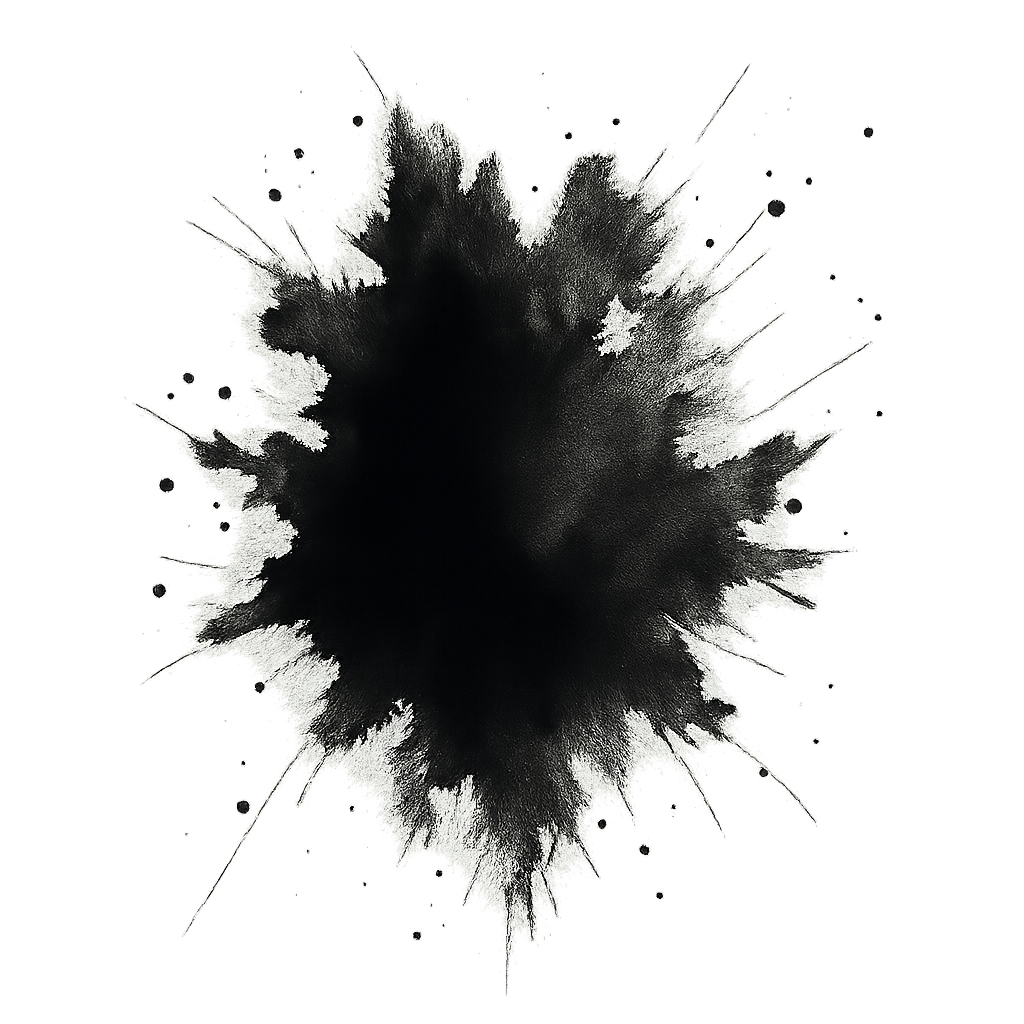
I am Râşid Efsûn. I am one of the hundreds of names interrogated because of a social event. I did not choose this name, which means “the spell that reveals the truth.” It was already prepared when I was born. After birth, it became my destiny. Do you believe in the relationship between names and destiny? In ancient times, millions of people did. For example, in Mesopotamian culture, a name was seen as a stamp given by the gods. It was believed that a person’s name determined their life path and their fate after death. In Christian and Islamic traditions, remember that in order to deal with disturbing abstract entities believed to affect a person, their names had to be known. To know a name was a way of controlling it. In medieval texts, knowing the names of evil spirits was important in exorcism rituals. The Islamic tradition is the same. Knowing the names of jinn serves as a key to summon and banish them.
In the Hebrew tradition, a change of name was perceived as a change of destiny. In other words, a name was God’s tool to rewrite fate. In Eastern mysticism such as Hinduism and Buddhism, it is considered an energy key that calls upon divine guidance and heals the soul. In Hurufism, a name is not only a word but also interpreted with the numerical values of its letters (abjad), seen as a code that determines spiritual identity and destiny. I think I have now explained better the relationship between my name and myself. By the way, I can no longer hear the muffled voice of the detective interrogating me, can you? Come, free yourself from this artificial stage surrounded by false decorations and pass through that ink stain to meet me on the real stage. I will tell you everything in its nakedness. But the room will not hear it, because what I will tell will not be a confession.
Shall we begin with the question: What is truth?
This question, carrying the potential to produce manipulation in political and digital planes, can be used to understand the architectural structure of a stage. For example, the sophists argued that truth is relative, that each individual constructs their own reality. Sounds different, doesn’t it? Let us call this “perceptual reality.” Eastern mysticism, however, defined truth as a hidden secret embedded within the unseen, and used intuition as the way to reveal it. In other words, truth was interpreted in a form that could be felt. Let us call this “intuitive reality.” According to the ancient Greek thinker Plato, truth is a form grasped not by the senses but by the mind. It is fixed, immutable, and cannot be bent according to individuals. Let us call this “Platonic reality.” These examples show how truth can appear on different stages, and they are also delicate stages that anyone pursuing truth must pay attention to.
If, while pursuing truth, you find yourself on the stage of perceptual reality and more importantly, if you have realized this, you must know that the truth of this stage is constructed not in the external world but within your plane of perception. In other words, the truth you define on this stage is only your truth. For instance, let us imagine a painting in any art gallery depicting a red stain. This stain could symbolize blood representing violence, it could be a ketchup mark referencing a kitchen performance, or it could simply be a paint stain. The answer you give is directly related to your perceptions. But if you are on the stage of intuitive reality, you focus not on what the stain resembles but on what it evokes in you. An inner expression such as “This stain reminds me of the red bird I saw in my dream” defines the bond you establish with the stain. Here, truth is not what the stain is, but what it makes you feel. According to the stage of Platonic reality? The red stain you see in that painting is simply a red stain. That’s all.
The sensational effect created by Dr. Eliah Voss or as he is commonly known, Dr. Voss through his social media post accompanied by an image of an ink stain can only be explained by such an illusion of truth. This post pulled back the curtains of the stage of reality and spoke directly to the “self” within us. But how could I have known that it would awaken inner power, and more importantly, transform this power into a collective flood? No one could have foreseen it. I will explain, but first I must speak of that social media platform where writers are in the majority. That timeless space where thoughts become visible through words, and sentences left into the void turn into seeds of resonance, transforming into auratic beings whose awakening time is unknown…
If you ask me what sound is, I would say “vibration.” Just as throwing a pebble into water causes ripples, sound spreads in the same way by causing ripples in the air, and through a series of processes triggered by the vibration of the eardrum, it evolves into neural waves and finally reaches the auditory cortex of the brain, where it gains meaning. For a sound to gain meaning, it must first be perceived. That is, a perceiver is required. The meaning derived from sound by the perceiver is stored in the mind in patterns, and thus when that sound is heard again, the meaning previously produced and recorded in memory is recalled. In other words, sound waves, which we can describe as the raw form of energy, are converted into a new format after a series of cognitive processes. We can briefly call this new format of energy “meaning.”
Meaning can sometimes be enriched with an emotional load. Because during the processing of sound waves, the limbic system can also become involved, and by attaching emotional bonds during the processing of that sound, it can increase the power of meaning. This process, reminiscent of a nuclear facility used to enrich uranium, does not require conscious effort to fulfill basic cognitive needs such as comprehension and understanding. In other words, it is an evolutionary mechanism.
Consciousness, by penetrating the layers of the mind, recalls the stored pattern of meaning; the more it recalls, the more permanent that sound becomes. Because with each recall, the synaptic connections between nerve cells are strengthened. In other words, a biological result is at play. A meaning sufficiently reinforced can, after a while, rise without requiring a call from consciousness, similar to how learning becomes automatic or habits are formed, and gain the power to occupy the mind. This is what I call an “auratic being.”
So why do I prefer the concept of auratic being? Because the word aura defines the invisible yet felt effect that a being radiates around itself. Since it is a representation produced by the mind but becoming independent of it and gaining its own identity, it surpasses the concept of “mental existence” preferred by classical paradigms. This being has no beating heart, yet it vibrates; it cannot speak in the conventional sense, yet it interacts; it does not breathe, yet it strives to live by producing echoes. I am speaking not of physical or biological dimensions, but of a neurological one. This being, having acquired the ability to act independently of consciousness, sometimes reaches such great power that it can block consciousness and cause a series of disturbances called passion or obsession. The metaphorical language I prefer to express the disturbance that may result from a meaning being kneaded too much in the mental dimension, like dough becoming hardened from over-kneading, is, of course, related to the foundations of neuroscience and psychoanalysis.
Just as the mental processing center can transform sound waves into meaning, it can also convert a meaning it has produced into sound waves or another form of expression. This process develops differently from automatic ready-made responses or reflexive speech. The intention, idea, or emotion that will form the core of a sentence is first constructed in the prefrontal cortex of the brain; structural functions such as grammar, sequencing, and emphasis are organized in the Broca’s area; the selection of words, their meaning, and contexts are assembled in the Wernicke’s area; and with the contribution of memory, the resulting product is sent to the motor cortex, if it is to be spoken, then through the muscles of the lips, tongue, and larynx; if it is to be written, then through the muscles of the hand and fingers. The product that emerges from these cognitive configuration processes, reminiscent of a production center, is an inner voice.
Such products were abundant on that social media platform dominated by writers. Some were laments directed at the past, the faded memory of a broken love, or the whisper of a timid hope for the future. Some inner voices had spilled out from the pages of a diary. Some were a challenge, a declaration, a manifesto, or a rebellion. All were seeds of resonance waiting to sprout and grow. Those seeds, in that timeless space, were released as vibrations waiting to be discovered by others. For these vibrations to transform into auratic beings, they first had to be received and interpreted by another mind, and internalized as part of its own inner world.
Dr. Voss’s post, like the others, was one of the millions of inner voices released into the digital universe. Perhaps a somewhat philosophical inquiry, perhaps the striking line of a poem laden with emotion, perhaps the pain of a broken heart, or perhaps a scream rising from the depths of the mind, a wish where hope turned into prayer, a fire where rebellion evolved into rage. Or maybe, beyond all these maybes, it was simply so. But once it was accepted and internalized by other minds, the incubation process that would transform it into an auratic being had begun.
This very beautifully portrays the difference in truth from person to person.
The truth can also change depending on circumstances and newfound ideals/knowledge.
Thanks for the perspective and fun read. ☺️
This is SO intense and compelling 🔥 It is at once a literary masterpiece and a spiritual manifesto 💯 I cannot remember having read something so utterly thought-provoking and engaging in recent memory 😲 BRAVO